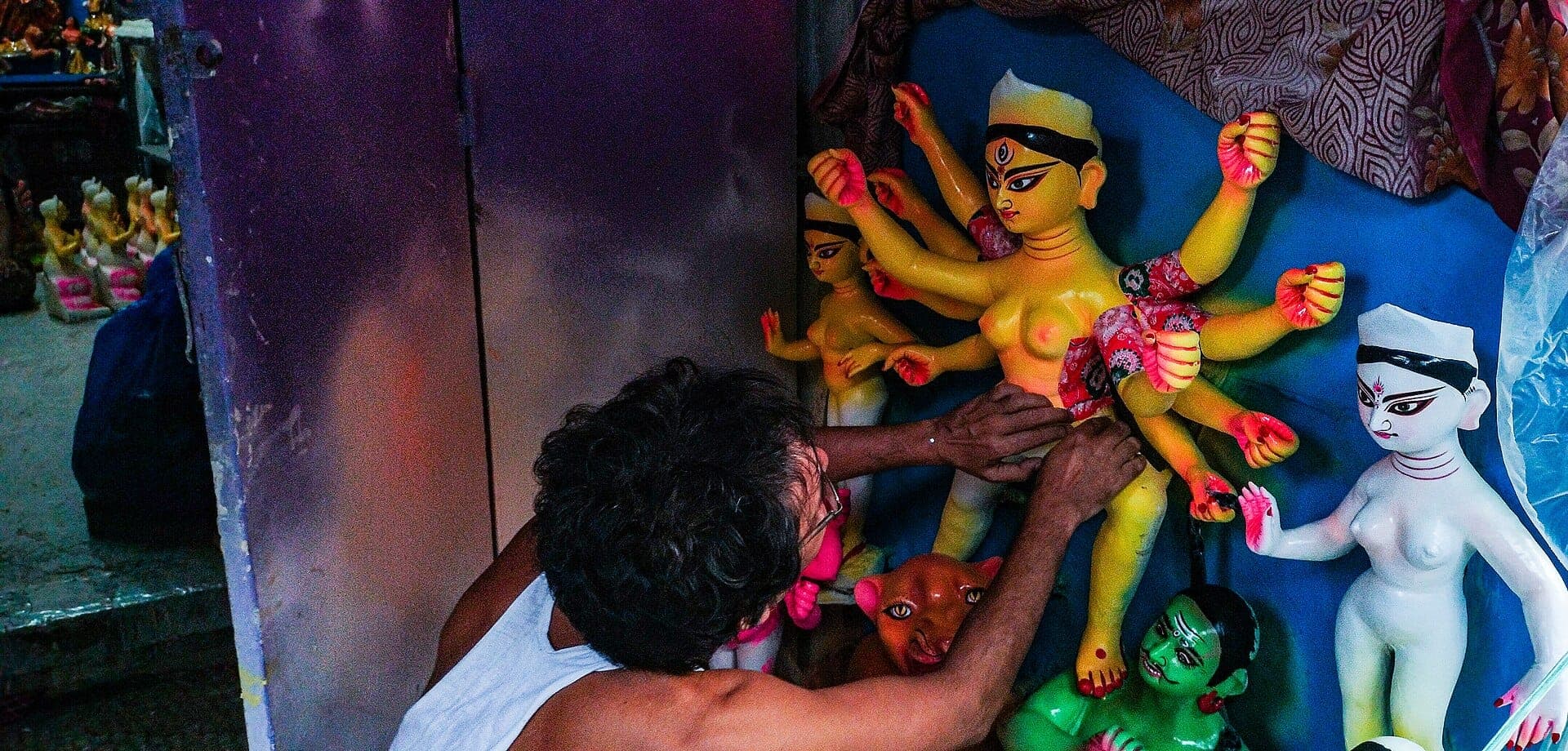
There are moulds now. A face can be cast, a torso can be pulled from fibreglass, and a large studio taking forty commissions in a season cannot do it any other way. This workshop takes eleven, and every face is modelled.
The argument for the mould is straightforward: it is faster, it is consistent, and it is what a committee working to a deadline wants. The argument against is that a moulded face is the same face, and it will be the same face next year.
What hand modelling actually means
The armature and the two clay coats are the same either way. The difference is the last week. The bele mati surface is worked wet, and the face, the fingers and the fall of the sari are cut and pressed with a handful of bamboo tools and a thumb.
The proportions come from the shilpa texts by way of a family tradition, which is to say approximately. The eyes are set slightly high, the chin is narrow, and the ten arms have to read as arms rather than spokes, which is harder than it sounds and is where most workshops fail.
“A mould gives you last year's goddess. I would rather make a worse one that is this year's.”
Who is still doing it
A handful of studios in the lanes, and the number is not growing. Fibreglass is lighter, survives transport to Dubai and New Jersey, and does not crack in a wet September.
Clay is also getting harder to obtain. Riverbank extraction is increasingly restricted, prices rise every year, and the entel mati from the right stretch of the Hooghly is a specific commodity, not just mud.
The eyes
On Mahalaya he fasts, bathes and does the eyes in one sitting: three strokes each, the third eye on the forehead, and the pupils last. It takes a few minutes. Everything else in the process can be argued about and this cannot.
Ten days later the figure is in the river and there is nothing left of five weeks of work. He has never regarded this as a problem, and finds the question slightly odd.
In January he starts binding straw.