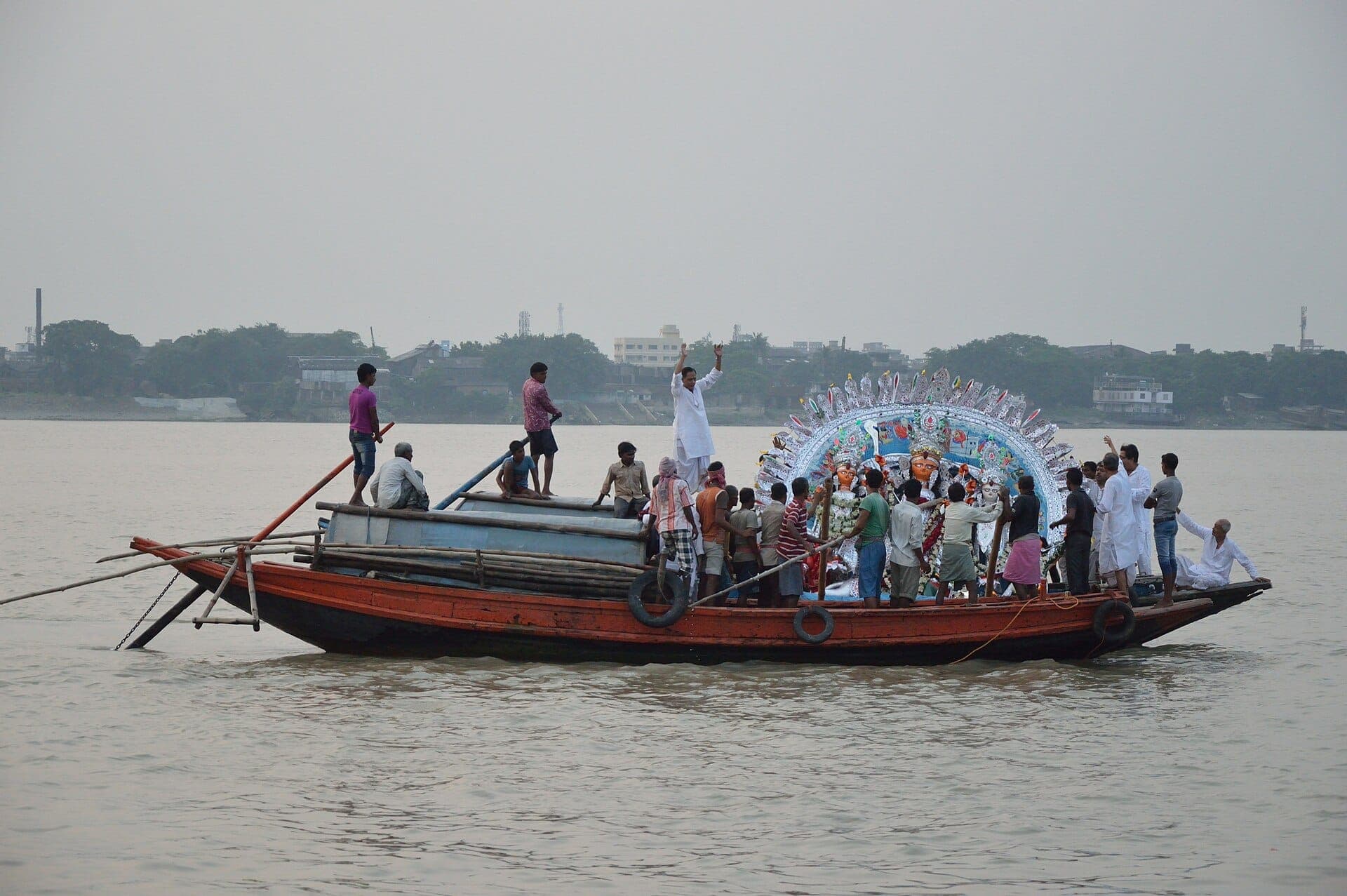
By two in the afternoon the lorries are backed up along Strand Road. Each carries one idol, lashed upright with rope, surrounded by the twenty or thirty people from the committee who have spent a year raising the money for it.
There is a police pass system, a queue, and a crane. There is also a great deal of standing about, which is the part nobody photographs.
Sindoor khela, an hour earlier
Before the lorry, at the pandal, married women mark the idol with vermilion and then each other, and feed her sweets for the journey. It is loud and it is not solemn. By the time the figure is on the truck a good proportion of the crowd is covered in red powder.
The last thing that happens at the pandal is that the priest performs a rite of departure, and somebody unbolts the frame from the platform it has stood on for five days.
At the ghat
The crane takes the larger figures. The smaller ones go in by hand, carried out into the water by eight or ten men who then hold on until the clay starts to go.
It goes faster than people expect. Straw and unfired clay in moving water is a matter of minutes. The paint is off first, then the surface, and then the shape is gone and there is a bamboo frame in the current.
“You spend a year on the committee and about ninety seconds on this part.”
What comes out again
Under the current rules the frames are recovered. Contractors with grappling hooks work through the night pulling bamboo, straw and the metal armatures back out, because a riverbed full of structural steel is a navigation problem as well as a pollution one.
Water-based, lead-free colours are required now. Compliance is uneven and improving, and the argument about it is conducted every year in the same newspapers.
By two in the morning the ghat is mostly empty. There is a lot of marigold in the water, some of it moving downstream, and the road is being swept. In Kumartuli the lanes are silent, and will be until January.