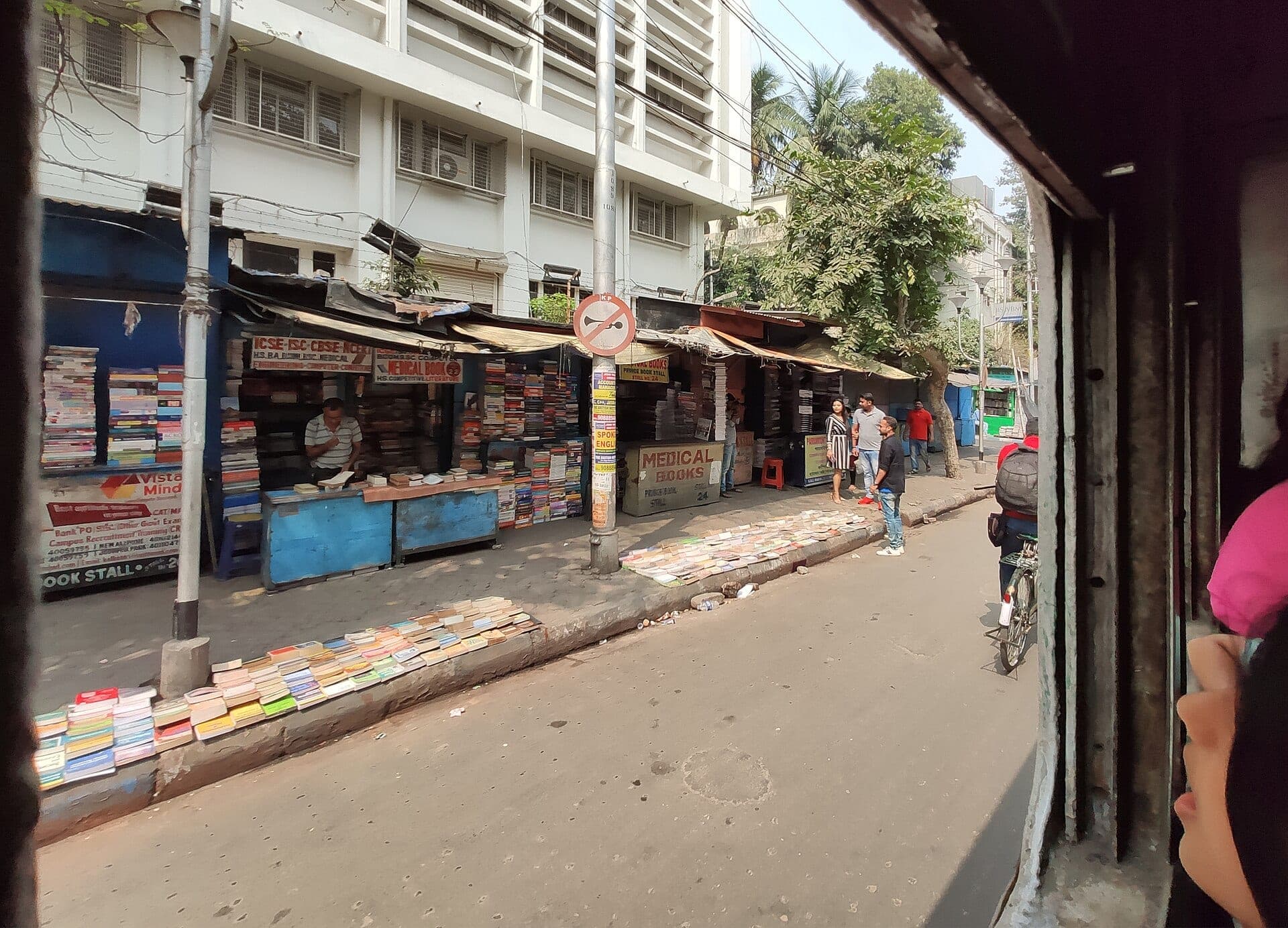
The stall is about six feet wide and eleven deep, if you count the part that folds out onto the pavement at eight in the morning and folds back at nine at night. There is no sign. There has never been a sign.
It was opened in 1948 by a man who had crossed from Faridpur the previous year with a trunk and no trade, and who started by selling secondhand school textbooks on a sheet on the ground.
The index
There is no catalogue and there never has been. You describe what you want, sometimes badly, and the current owner, who is the founder's grandson, goes into the stack. Eleven minutes is about the average.
The system is spatial and it is entirely in his head: Bengali fiction along the back at chest height, English paperbacks in the front left, academic titles in the plastic crates, and anything unusual in the bundle behind the ladder that only he is allowed to touch.
“My grandfather knew where everything was. My father knew where everything was. I know where everything is. Nobody has written it down.”
Three collapses
The trade nearly went three times. In the 1970s, when the university closed for long stretches during the Naxalite period and the student customers stopped coming. In the 1990s, when cable television arrived. And from about 2010, when online sellers made new books cheaper than his secondhand ones.
What saved it each time was the same thing: the stock nobody else has. A 1962 Bengali translation of a Russian novel, a mimeographed thesis, a little magazine from 1974 with four poems in it that were never collected.
The fourth generation
The daughter is at Presidency, two hundred metres up the road, reading comparative literature. She helps at the stall on Sundays and has started keeping a spreadsheet, which her father regards with visible suspicion.
Whether she takes it on is not settled. What is settled is that when a stall closes on this street it is not replaced by another stall.