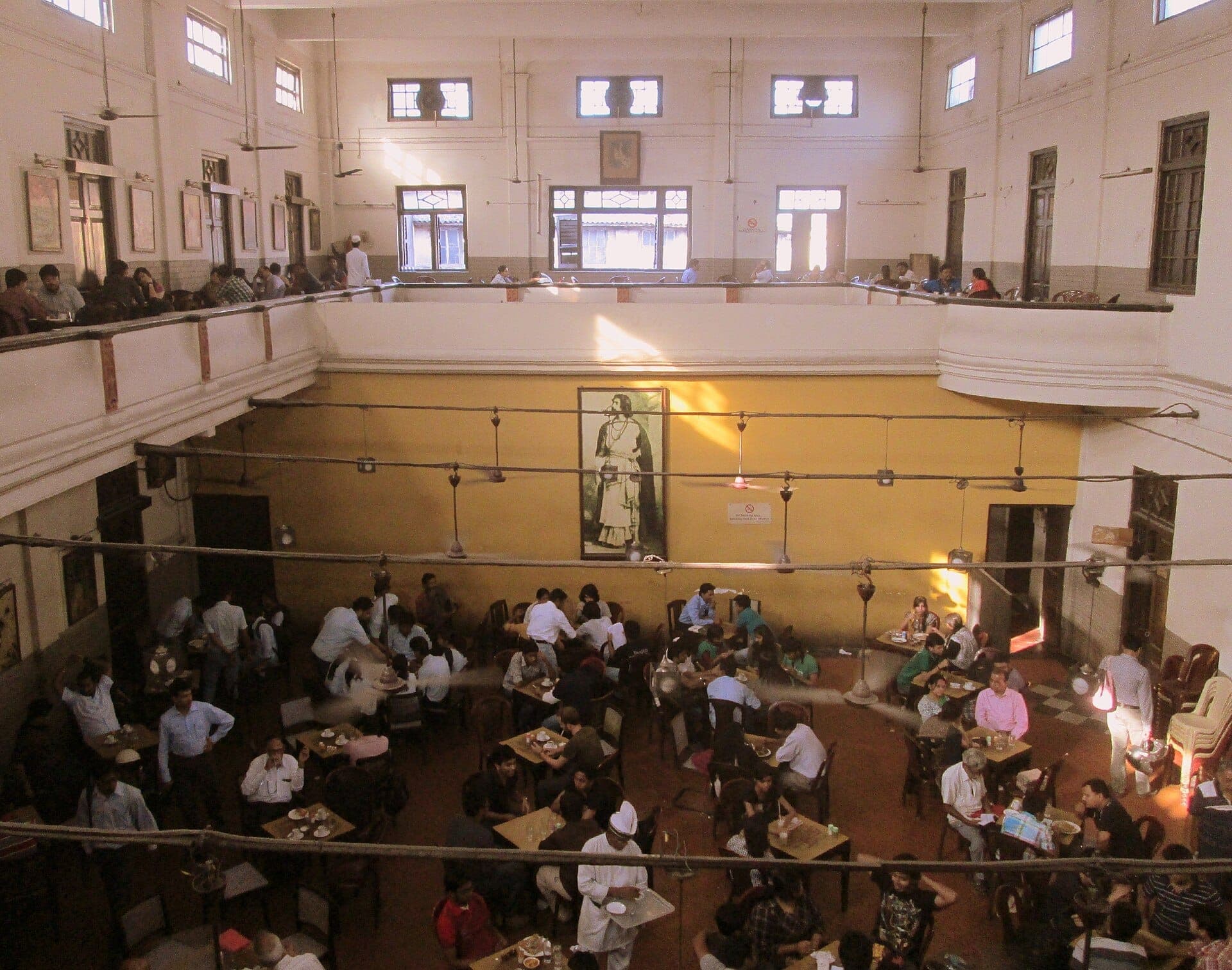
The building opened as the Albert Hall in 1876 and became a coffee house in 1942. The ceiling is very high, the fans are slow and inadequate, the acoustics are appalling, and this is a large part of why it works: nobody can hear the next table, so everyone talks louder, so the room sounds like a single argument.
Adda has rules, and the first is that it must be unproductive. A meeting is not an adda. A discussion with an agenda is not an adda. It must go on longer than it needs to, it must digress, and nobody should leave having decided anything.
The second rule is that the table is more permanent than the people. Groups held the same table for decades. Membership changed by attrition. You did not join, you were absorbed, usually by being brought once by someone else and then simply continuing to turn up.
Who sat here
Satyajit Ray, before Pather Panchali, when he was still designing book jackets. Mrinal Sen, at greater length and more argumentatively. Ritwik Ghatak. Amartya Sen as a Presidency undergraduate. The Krittibas poets in the fifties. The entire Naxalbari student leadership in the late sixties, until it became unwise to be seen doing so.
Manna Dey's song about the Coffee House, recorded in 1983, is about the fact that the table is still there and the people are not. It is played at the volume of a national anthem at Bengali gatherings anywhere in the world, and it is a song about seven friends of whom one is dead, one is in Delhi, one has married badly, and one has become successful, which is worse.
The order
Infusion, which is black coffee, or cold coffee, which arrives with a scoop of something. A mutton afghani cutlet. Perhaps a plate of chicken pakora. The food is not the point and everyone involved knows it is not the point.
The waiters wear white with a fan-shaped turban and a broad cummerbund. The uniform is a leftover of the Indian Coffee Board's original service and was retained when the workers took the chain over as a cooperative in 1958. The staff have owned the place since.
It is louder now, and younger, and a substantial fraction of the room is on a phone. The complaint that the adda is not what it was has been made continuously since approximately 1961, which suggests it is a feature of the institution rather than evidence about it.