The first one was pulled by horses. On 24 February 1873 a metre-gauge track opened between Sealdah and Armenian Ghat, three and a half kilometres, and it failed within nine months. A second attempt in 1880 stuck. By 1902 the wires were up and Calcutta had the first electric tramway in Asia.
At its largest the network ran to more than sixty kilometres of track and thirty-seven routes, and it was not nostalgia, it was infrastructure. It moved mill workers to Kidderpore and clerks to Dalhousie and students to College Street, at a fare that stayed under a rupee well into a period when nothing else did.
“It is the only vehicle in this city that has never been in a hurry.”
What a tram is actually for
A tram is slow. This is the complaint and it is also the case for it. A tram at fifteen kilometres an hour on a dedicated median does not stop for the traffic beside it, does not emit at the point of use, and carries two hundred people using less road space per passenger than any bus. In a city with among the lowest road-area ratios of any Indian metropolis, roughly six per cent against Delhi's twenty-plus, that arithmetic should have been decisive.
It was not decisive. Routes were suspended for road works and never restored. Tracks were tarred over during flyover construction. The rolling stock aged, the depots emptied, and by 2023 two routes were running out of what had been thirty-seven.
In 2024 the state government said the plan was to retain a single heritage route, Esplanade to Maidan, as a joyride. Campaigners went to the High Court. The case has moved slowly and the tracks have not moved at all.
The Tollygunge line
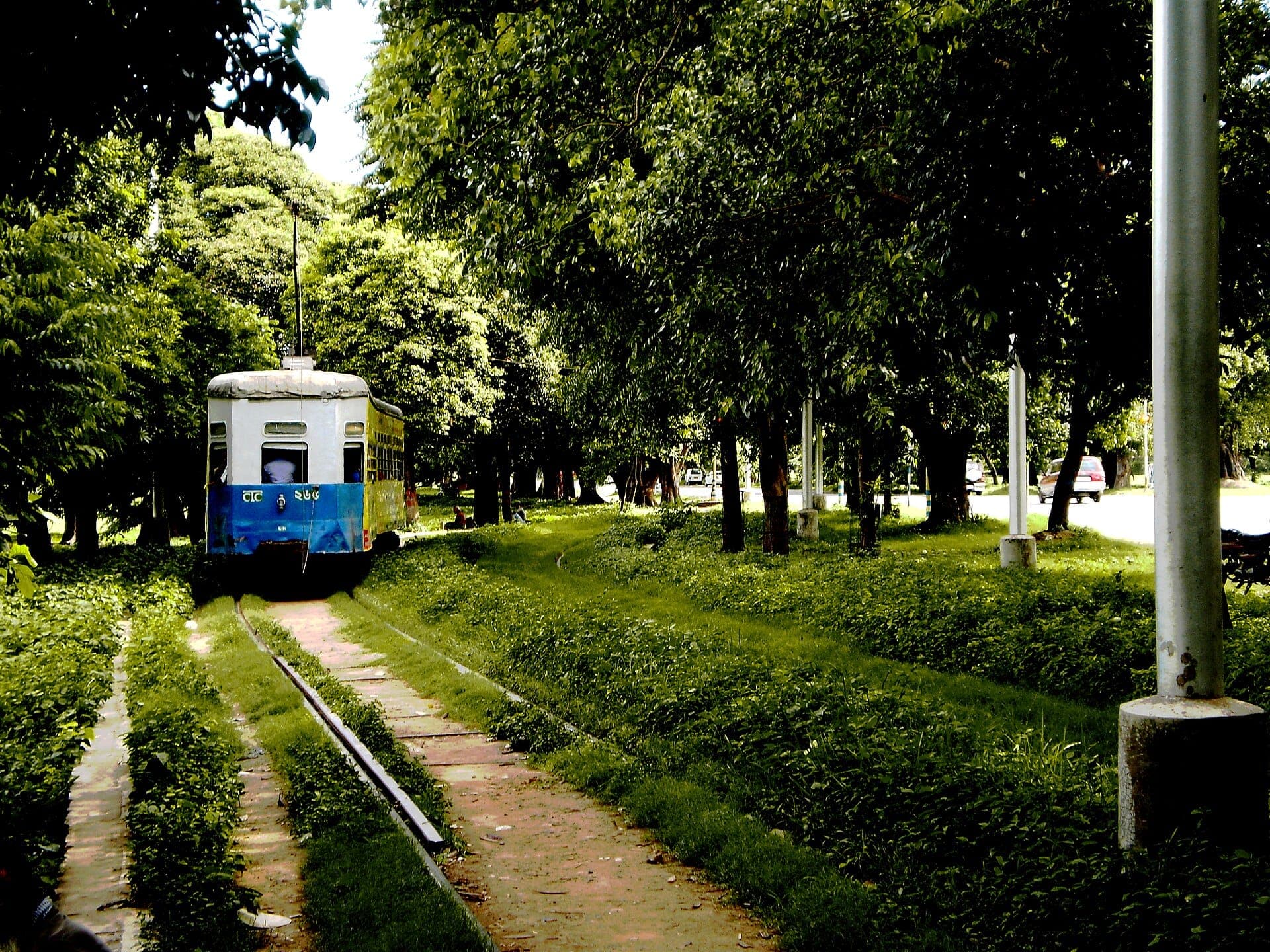
Route 24 ran from Ballygunge to Tollygunge through Rashbehari, down a median of grass and rail that had been there since before Partition. In the afternoon it carried schoolchildren, and the conductor knew which stop each of them wanted and would call it without being asked.
There was a particular quality to the light in a tram in October, coming through the wooden slats of the window on the western side at about four o'clock, with a fan turning too slowly overhead. Nobody built that. It was a side effect of a vehicle designed in 1926 that nobody had got around to replacing.
The Calcutta Tram Users' Association still meets. The Tram World museum car sits at Esplanade depot with two coaches and a small display. On a good day, if you ask, someone will start one up so you can hear the compressor.
Melbourne kept its trams. So did Lisbon, Prague, Amsterdam, San Francisco. All of them were told at some point in the twentieth century that trams were obsolete, and all of them worked out that a tram is not a nineteenth-century object but a twenty-first-century one that happens to have arrived early.