Famous for
Kolkata is famous for…
Eight strands, and the specific things inside each one. Almost every item here has a page of its own somewhere on this site.
- Things
- 58
Food
Mustard oil, freshwater fish, fresh curd cheese, and a relationship with sugar other cuisines find excessive.
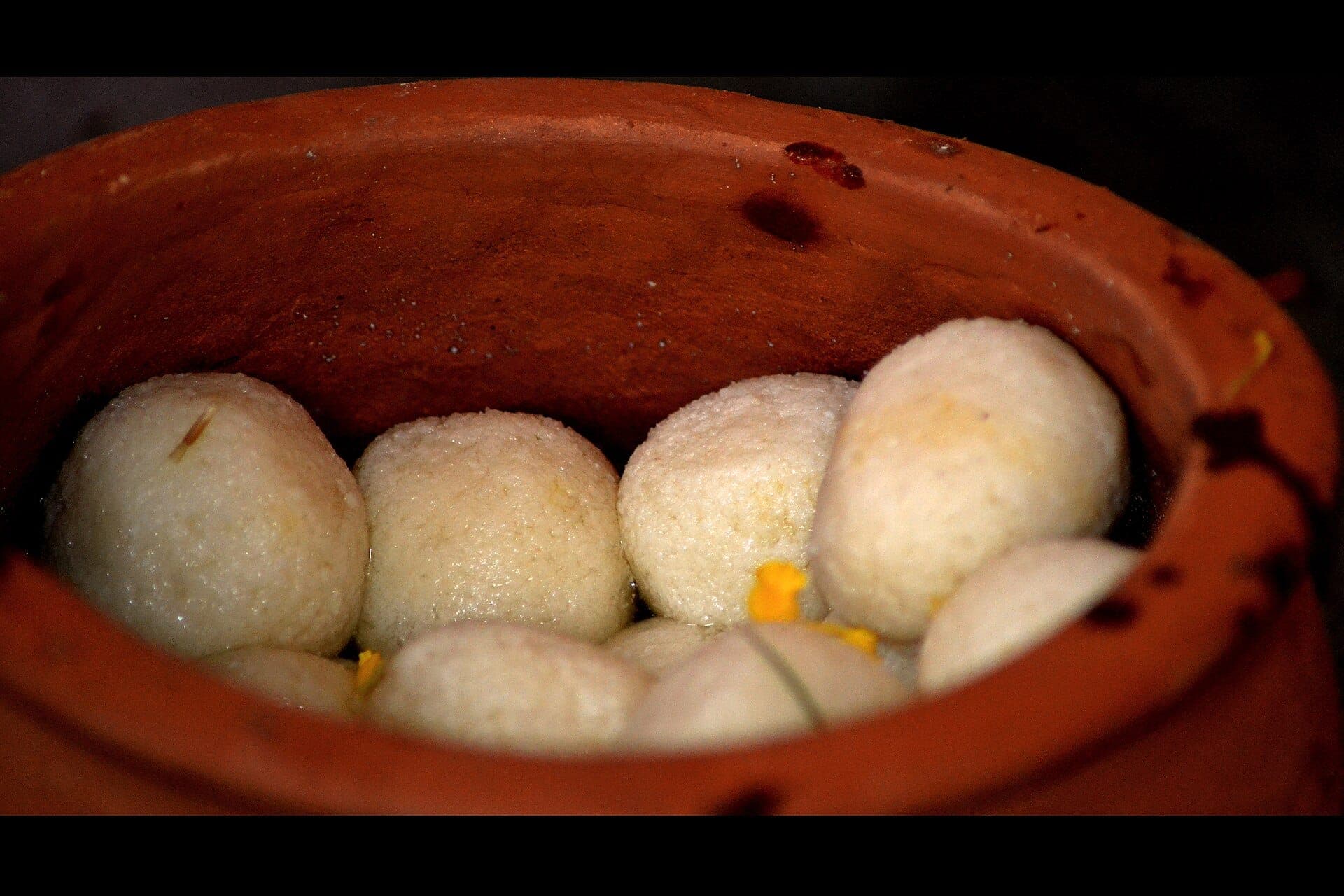
- Rosogolla →
Chhena boiled in thin syrup. Nobin Chandra Das, Bagbazar, 1868.
- Mishti doi →
Yoghurt set with caramelised sugar in an unglazed clay pot.
Sandesh
Chhena and sugar, and about forty named variations.
- Kathi roll →
Kebab off the skewer in an egg paratha. Nizam's, 1932.
- Kolkata biryani →
Lighter, perfumed, and containing a whole potato.
- Telebhaja →
Things fried in besan. The smell of the monsoon.
- Phuchka →
Sour, not sweet. Never call it pani puri here.
- Jhalmuri →
Puffed rice shaken in a tin, in ninety seconds.
Ghugni
Yellow peas with coconut and chilli, sold from a handcart.
- Luchi →
Maida puris that puff into spheres. Never atta.
Alur dom
Baby potatoes, sweet-sour, finished with ghee.
- Kosha mangsho →
Mutton cooked down until the gravy becomes a coating.
Fish
Bhetki, pabda, parshe, koi, chitol, and hilsa in the monsoon.
Chingri malai curry
Prawns in coconut milk. The name has nothing to do with Malay.
Books
A city that will still buy poetry at scale, which almost no other market anywhere does.
- College Street →
A mile and a half of secondhand stalls.
Boi Para
The book neighbourhood. Publishers, printers and binderies behind the stalls.
Presidency University
Founded 1817 as Hindu College, and the engine of the Bengal Renaissance.
University of Calcutta
1857. The first multidisciplinary Western-style university in Asia.
Indian Coffee House
Worker-owned since 1958. The room where the century was argued out.
Kolkata Book Fair
Two million visitors over twelve days. The largest non-trade fair anywhere.
Little magazines
Hundreds of them, hand-stapled, and where the actual literary culture is.
Football
In 1911 a barefoot Indian team beat a British regiment in a final, and the city has not stopped talking about it.
Mohun Bagan
Founded 1889. Beat East Yorkshire Regiment 2–1 barefoot in the 1911 IFA Shield.
East Bengal
Founded 1920. After Partition, the club of those who came from the east.
Mohammedan Sporting
Founded 1891. Won five consecutive Calcutta League titles in the 1930s.
- The Maidan →
All three clubs' tents, within a few hundred metres of each other.
The derby
Salt Lake Stadium, over a hundred thousand, and prawn against hilsa in the fish market.
Salt Lake Stadium
Once above 100,000 capacity, and still among the largest anywhere.
Cinema
Three filmmakers, within ten miles of each other, made three completely different arguments about what a film could be.
Satyajit Ray
Pather Panchali, 1955, shot on weekends over two and a half years.
Ritwik Ghatak
Eight features, mostly about Partition, mostly commercial failures.
Mrinal Sen
Broke the fourth wall in Interview and Calcutta 71, and never apologised.
Uttam Kumar & Suchitra Sen
Thirty films, and the shared memory of a generation.
- Tollywood →
Named for Tollygunge, where New Theatres established the industry in the 1930s.
Nandan
The state film centre, designed with Ray's involvement, and the festival's home.
Theatre
A professional stage since the 1870s, a group theatre movement since the 1940s, and jatra companies still cast on Chitpur Road.
Bengali theatre
Girish Chandra Ghosh built the professional stage: paid companies, six nights a week.
Group theatre
From the 1940s: Bohurupee, Nandikar, Theatre Workshop. Political, and unsubsidised.
- Jatra →
Folk theatre in the round, played to village audiences of thousands.
Star Theatre
1883, built on Binodini Dasi's earnings and named without her.
Utpal Dutt
Wrote for the proscenium and the jatra stage with equal seriousness.
Sombhu Mitra
Founded Bohurupee, and staged Rabindranath as living theatre rather than heritage.
Art
The Bengal School turned Indian painting away from Victorian realism, and the pandals turned a festival into the largest public art programme on earth.
Bengal School
Abanindranath Tagore and Nandalal Bose, from 1905. Wash technique, Asian idiom.
Government College of Art
1864. Where Abanindranath taught and the school was formed.
- Kalighat pat →
Fast, flat, satirical brush paintings sold to pilgrims from the 1830s.
Jamini Roy
Took the Kalighat idiom and made a modern practice out of it.
- Pandal art →
Thousands of commissioned installations, built and destroyed inside a fortnight.
Contemporary galleries
Experimenter, Emami Art, the Kolkata Centre for Creativity, Akar Prakar.
Music
Two thousand songs by one man, and a city that still keeps a harmonium in the front room.
Rabindra Sangeet
Around 2,230 songs, set by Tagore himself, and the default emotional vocabulary.
Nazrul Geeti
Kazi Nazrul Islam's songs: ghazal, kirtan, and a great deal of political fury.
Baul
Wandering mystic singers of rural Bengal, on the UNESCO list since 2005.
Bengali bands
Mohiner Ghoraguli in the 1970s, then Cactus, Chandrabindoo, Fossils.
Classical music
The Dover Lane Music Conference each January, running all night for four nights.
- Park Street jazz →
Trincas, Blue Fox and Moulin Rouge, and a circuit that produced Usha Uthup.
Festivals
The calendar is the city's real infrastructure, and almost all of it lands between September and February.
- Durga Puja →
UNESCO listed in 2021. Several thousand pandals, built and gone in a fortnight.
Kali Puja
Bengal's answer to Diwali, on the same new moon but for Kali.
Poila Boishakh
Bengali New Year. Shops open new account books and hand out sweets.
Saraswati Puja
Every school and college. Yellow, and the city's unofficial Valentine's Day.
Jagaddhatri Puja
At Chandannagar, with the best light installations in India.
Christmas
Park Street arched with lights, and Bow Barracks with homemade wine.
Eid
Zakaria Street below Nakhoda Masjid, on charcoal, for a month.
Keep going